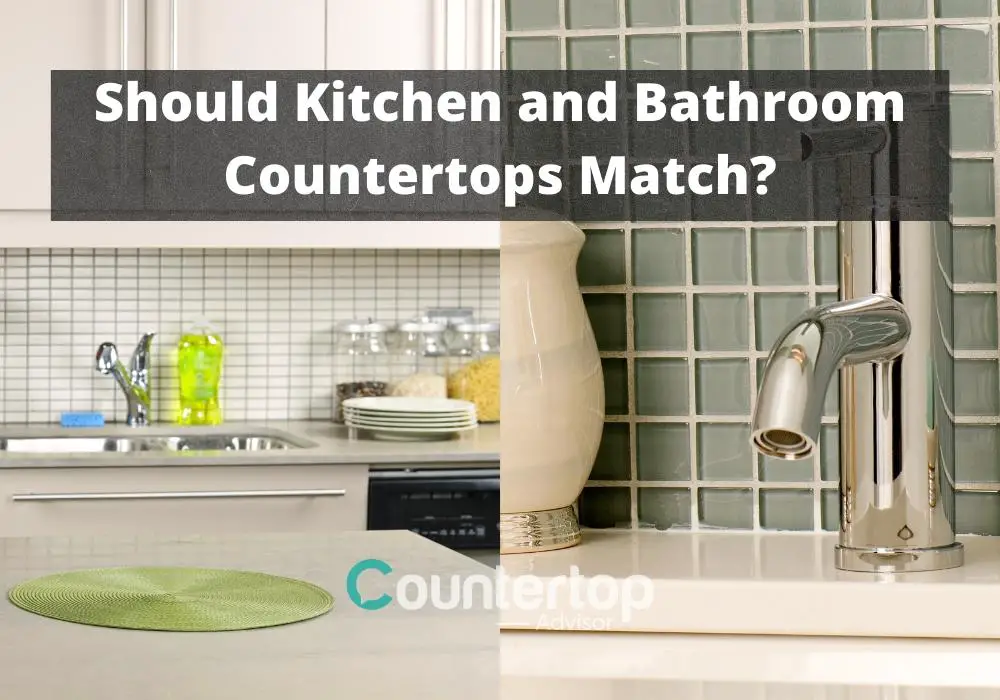
Kitchen and bathroom countertops do not have to match — and in most homes, they shouldn’t be identical. The right answer depends on three things: can you see the bathroom from the kitchen? (if yes, lean toward matching or closely coordinating; if no, freedom to vary). Are the rooms next to each other or far apart? And do the two rooms have meaningfully different needs? — a heavy-cooking kitchen and a powder-room vanity have very different demands. After 10 years installing countertops in both spaces, here’s how to make this decision and the design principle that matters more than matching.
The Honest Answer: Coordinate, Don’t Match
Identical countertops in every room of a house tend to feel flat and unintentional — like the homeowner ran out of design ideas. Coordinated countertops — ones that share a color family, undertone temperature, or design language without being the exact same stone — feel intentional and let each room serve its purpose. That’s the modern designer consensus: matching styles share themes and aesthetics, while complementary styles vary the materials but keep them in conversation with each other.
The 2026 design direction goes a step further. Designers are increasingly mixing materials deliberately to define zones and add visual interest — granite or quartzite in the heavy-use kitchen, marble or a marble-look quartz in the primary bathroom, a budget-friendly choice in the powder room. The unifying principle isn’t material; it’s a consistent color palette and design intent across the home.
The Three Questions to Ask Yourself
1. Can You See Both Rooms at Once?
This is the single most useful test. If you stand in the kitchen and can see directly into the bathroom — common with powder rooms off open kitchens — you have a sightline. Countertops in the same sightline should match closely or coordinate strongly, because the eye sees them as one composition. If the bathroom is on a different floor, behind closed doors, or out of any normal sightline from the kitchen, the rooms don’t visually share a frame — you have far more freedom to vary.
2. How Close Are the Two Rooms?
Adjacent rooms (a powder room off a hallway, a half-bath off the kitchen) want coordination. Distant rooms (a primary bath upstairs, a basement bathroom) can be fully independent. The further apart and more visually separated the rooms, the less matching matters.
3. Do the Rooms Have Different Functional Needs?
A heavy-cooking kitchen wants a hard, heat-resistant, scratch-resistant surface — granite, quartz, or quartzite. A bathroom vanity sees light use and can prioritize aesthetics — this is where homeowners often choose marble or a softer, more delicate-looking stone they couldn’t put up with in a kitchen. Matching identical countertops in both rooms means either over-spec’ing the bathroom or under-spec’ing the kitchen.
When Matching Makes Sense
- Open-plan homes where the kitchen and a half-bath are in the same sightline.
- Small homes where coordinated materials make the space feel larger and more cohesive.
- Resale-focused remodels — buyers find coordinated finishes easier to picture themselves in than a jumble of materials, and timeless neutrals (whites, grays, beiges) help.
- When you find a buy-in-bulk price — if your fabricator offers a discount on extra square footage of the same slab, matching can save real money.
- For decision fatigue — picking one stone for both rooms is simpler than picking two.
When Mismatching Makes Sense
- Rooms are far apart or on different floors with no shared sightline.
- The rooms have very different design tones — a sleek modern kitchen and a traditional spa-like primary bath both work better with materials suited to each style.
- Different functional needs — granite or quartzite in the heavy-use kitchen, marble in the lighter-use bathroom for the look you can’t justify near the stove.
- Budget allocation — spending more on the kitchen (the room people see most and that affects resale most) and choosing a budget-friendly material for a guest bath.
- Mixed-material design — deliberately layering different countertops (different stone on the island vs. perimeter, different stone in the prep zone vs. the bar) is a strong 2026 trend that depends on intentional mixing.
How to Coordinate Without Matching
If you want the rooms to feel related without being identical, work with these levers:
Match the undertone temperature. If your kitchen countertop is cool-toned (gray, blue, cool white), keep the bathroom cool too. If warm (cream, beige, gold), keep the bathroom warm. A cool-toned kitchen next to a warm-toned bathroom feels disconnected even if both are beautiful in isolation.
Match the color family loosely. Different stones in the same broad color family read as part of the same home. A Carrara marble in the bathroom and a marble-look quartz in the kitchen, both in the white-and-gray family, coordinate beautifully without being the same stone.
Match the design tier. A premium kitchen counter wants a premium-tier bathroom counter (not necessarily the same material, but the same level of stone or quality). Pairing a luxury Calacatta kitchen with a builder-grade laminate bathroom in the same sightline reads as inconsistent.
Repeat one element. Even with different counters, repeating the same edge profile, the same backsplash style, or the same hardware finish ties the rooms together. See my edge profile guide and color-matching guide.
What About Resale Value?
Buyers respond to cohesion and timelessness, not to identical materials. Coordinated countertops in neutral tones (white, gray, beige) consistently outperform either rigid matching or chaotic mismatching — consistent with current 2026 kitchen design coverage. A kitchen in a clean white-and-gray granite or quartz, paired with a complementary marble or quartz bathroom vanity in the same broad palette, is what most buyers respond to. Bold contrasts can hurt resale even when individually beautiful, because they make it harder for buyers to picture their own things in the space. See my granite resale value guide for more.
The Single Most Common Mistake
Picking the kitchen countertop first, falling in love with it, and then picking a bathroom countertop in isolation without considering the kitchen at all. Even if the two rooms aren’t in a shared sightline, the home reads as a single environment to anyone walking through. Pick the kitchen first — it’s the higher-stakes decision — then choose the bathroom counter to either coordinate (preferred) or deliberately contrast (only if you have a clear design reason).
Frequently Asked Questions
Do kitchen and bathroom countertops have to match?
No. Matching is a design choice, not a requirement. The 2026 designer consensus favors coordination — countertops in the same color family or undertone temperature, not necessarily identical — over rigid matching.
Should the kitchen and a powder room off the kitchen have the same countertop?
If you can see one from the other (a shared sightline), yes — either match or closely coordinate. If the powder room is around a corner or behind a closed door, you have more freedom.
Does matching countertops add resale value?
Coordinated finishes in timeless neutrals add resale value; rigidly matching every room doesn’t necessarily. Buyers respond to a home that feels cohesive and easy to picture themselves in, not to identical materials throughout.
Can you mix different materials in the kitchen and bathroom?
Yes — this is increasingly the design preference. Use a harder, more durable material like granite or quartz in the heavy-use kitchen and a softer, more delicate material like marble in the lighter-use bathroom. Coordinate by color family and undertone, not by material.
How do I make different countertops feel cohesive?
Match the undertone temperature (both warm or both cool), keep the rooms in the same color family, match the design tier (both premium or both modest), and repeat a unifying element like edge profile or hardware finish. See my countertop color guide.
For the underlying material/threat differences between the two spaces, see kitchen vs bathroom countertops.
Once the countertop’s settled, the sink decision comes next. See my best bathroom sinks guide — vessel, undermount, and drop-in compared.