White marble countertops are the most timelessly beautiful surface you can put in a kitchen — and the most demanding to live with. Every white marble falls into one of a few families: Carrara (soft gray feathery veining, the affordable workhorse), Calacatta (bright white with bold gray-and-gold veining, the dramatic luxury option), Statuary/Statuario (bright white with crisp gray veining), and a range of regional whites like Danby (the American marble) and Thassos (pure white). After 10 years installing marble, here’s how to tell the major white marbles apart, what they cost, and the honest truth about living with marble countertops.
The Two Names That Matter Most: Carrara vs. Calacatta
Most white-marble confusion clears up once you understand these two. They’re often used interchangeably — incorrectly.
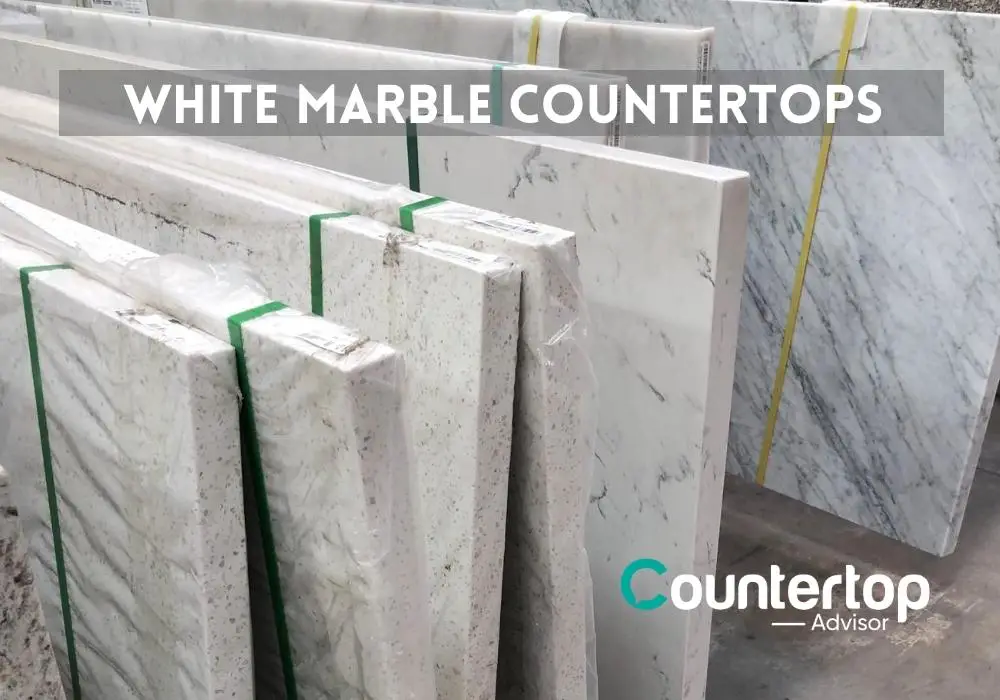
Carrara marble has a light gray background (sometimes with a faint blue cast) and soft, feathery, fine gray veining spread fairly evenly across the slab. It reads calm and subtle. Carrara is quarried in large quantities in the Carrara region of Italy, which makes it the most affordable and widely available white marble — roughly $40–$80 per square foot installed.
Calacatta marble has a brighter, whiter background and bold, dramatic veining — thicker gray veins, often with gold or warm tones running through. It reads as a statement. Calacatta is rarer than Carrara, so it costs considerably more — roughly $100–$200+ per square foot installed. Because its veining is so striking, Calacatta is the marble most often bookmatched (two sequential slabs mirrored to create an open-book pattern).
Quick rule: whiter background + bolder veins = Calacatta; grayer background + soft feathery veins = Carrara. Statuary (Statuario) sits between — bright white like Calacatta but with crisper, more linear gray veining.
The Major White Marble Varieties
Carrara Family
Bianco Carrara — the classic: soft gray field, fine feathery veins. Arabescato Carrara — a Carrara with bolder, more arched “arabesque” veining. Carrara Silver — cooler, more silver-gray toned. Bianco Venatino — a whiter Carrara with linear veining.
Calacatta Family
The most extensive group, because “Calacatta” covers many sub-quarries: Calacatta Oro (gold veining — the warm classic), Calacatta Borghini and Calacatta Michelangelo (bright white, bold gray), Calacatta Belgia, Calacatta Caldia, Calacatta Lincoln, and others. They share the bright-white-bold-vein character; the differences are vein color, thickness, and density.
Statuary and Bright Whites
Thassos — a near-pure-white Greek marble with minimal veining, the whitest of the whites. Opal White, Salt White, Montclair White, Mountain White, Noble White, Fantasy White — bright whites with varied veining; availability and naming vary by supplier.
Danby (American Marble)
Imperial Danby and Olympian White Danby — quarried in Vermont (the Natural Stone Institute recognizes Danby as a premier American marble), Danby is slightly harder and less porous than Italian marble, with soft golden or gray veining. A good choice if domestic sourcing matters to you.
Other Whites
Crema Marfil (a warm cream-beige rather than true white, Spanish), Bianco Neve, Bianco Rhino, Saint Moritz, Silver Cloud, Solto White, White Truffle, Manhattan — a wide field of regional and supplier-specific whites. As always with natural stone, the same name can look different slab to slab, and view the actual slab before buying.
What All White Marble Has in Common: The Honest Part
Whichever white marble you choose, the care reality is the same, because all marble is calcite-based — a metamorphic carbonate rock:
It etches. Marble rates just 3 on the Mohs hardness scale, and calcite reacts chemically with acids. Lemon juice, wine, vinegar, tomato, even some cleaning products leave dull etched marks. Etching happens even on sealed marble — sealer slows staining but does not stop the acid reaction. This is the single most important thing to understand before choosing marble.
It needs frequent sealing. Marble is porous and should be sealed roughly every six months to resist staining. See my marble sealing guide.
It scratches more easily than granite or quartzite.
Here’s the honest installer insight: busier-veined marbles hide etching better. A Carrara with its feathery all-over veining camouflages the inevitable light etches and marks of daily cooking far better than a stark, minimally-veined white like Thassos, where every etch shows. If you love marble but cook a lot, a busier Carrara is the more forgiving daily choice. Choosing a honed (matte) finish over polished also hides etching significantly better.
Who Should Choose White Marble
Marble is right for you if: you love the look enough to either keep acidic spills off it or accept the etched patina as character; it’s a lower-use surface (a baking station — marble is genuinely great for pastry — a bathroom vanity, a butler’s pantry); or you simply want the iconic look and have made peace with the maintenance.
Consider an alternative if: you cook heavily with acidic ingredients and want a worry-free surface, or you want the marble look without the upkeep. In that case, a marble-look quartzite gives you 90% of the appearance with far better durability, and a marble-look quartz (Caesarstone, Cambria, Silestone all make excellent ones) is non-porous and etch-proof. See my quartzite vs marble comparison.
White Marble Cost Summary
| Marble Type | Installed $/sq ft | Character |
|---|---|---|
| Carrara | $40–$80 | Soft gray feathery veins, affordable |
| Statuary / Statuario | $80–$150 | Bright white, crisp gray veins |
| Calacatta | $100–$200+ | Bright white, bold gold/gray veins, luxury |
| Danby (American) | $80–$150 | Vermont-quarried, slightly harder |
Frequently Asked Questions
What’s the difference between Carrara and Calacatta marble?
Carrara has a grayer background with soft, feathery, fine veining and is the more affordable, widely available option. Calacatta has a brighter white background with bold, dramatic gray-and-gold veining and costs considerably more because it’s rarer. Whiter background plus bolder veins means Calacatta; grayer with soft veins means Carrara.
Do white marble countertops stain and etch easily?
Yes. All marble is calcite-based, rates only 3 on the Mohs scale, and etches from acidic substances (lemon, wine, vinegar, tomato) even when sealed. It’s also porous and needs sealing roughly every six months. Busier-veined marbles like Carrara hide etching better than stark whites.
What is the most affordable white marble countertop?
Carrara — roughly $40–$80 per square foot installed. It’s quarried abundantly in Italy, making it the most available and budget-friendly true white marble. Calacatta, by contrast, runs $100–$200+ per square foot.
Is white marble good for kitchen countertops?
It can be, if you accept its terms. Marble is beautiful and excellent for baking, but it etches and stains and needs regular sealing. It’s best for homeowners who either maintain it carefully or embrace the patina, and for lower-use surfaces. Heavy cooks who want worry-free surfaces should consider marble-look quartzite or quartz instead.
Which white marble shows etching the least?
Busier-veined marbles like Carrara and Arabescato camouflage etches and light marks much better than stark, minimally-veined whites like Thassos. A honed (matte) finish also hides etching far better than a polished finish. For a heavy-use kitchen, busy-veined and honed is the most forgiving combination.
For more, see my guides on quartzite vs marble, sealing marble countertops, and how to clean marble.
For the bathroom-specific decision on marble, see should you use marble in the bathroom — daily acidic spills (the kitchen problem) are largely absent in a bathroom.
For the kitchen-specific marble decision, see should you use marble in a kitchen — sealer can’t stop etching, so the right framing is whether you love the look enough for the patina.