Granite and quartzite are both 100% natural stone countertops, both extremely durable, and both excellent kitchen surfaces — but they differ in a few ways that matter. Quartzite is harder and more scratch-resistant; granite is more impact-forgiving and usually cheaper. Quartzite typically costs 30–50% more than granite. Both need periodic sealing, both handle heat well, and both last for decades. After 10 years installing both, here’s the honest head-to-head so you can choose between granite and quartzite.
Granite vs. Quartzite at a Glance
| Factor | Granite | Quartzite |
|---|---|---|
| Rock type | Igneous (natural) | Metamorphic (natural) |
| Hardness (Mohs) | 6–7 | 7 |
| Scratch resistance | Excellent | Excellent (slightly higher) |
| Heat resistance | Excellent | Excellent |
| Sealing | Periodic | Periodic (often less often) |
| Installed cost / sq ft | $40–$100 | $60–$150 |
What They Are
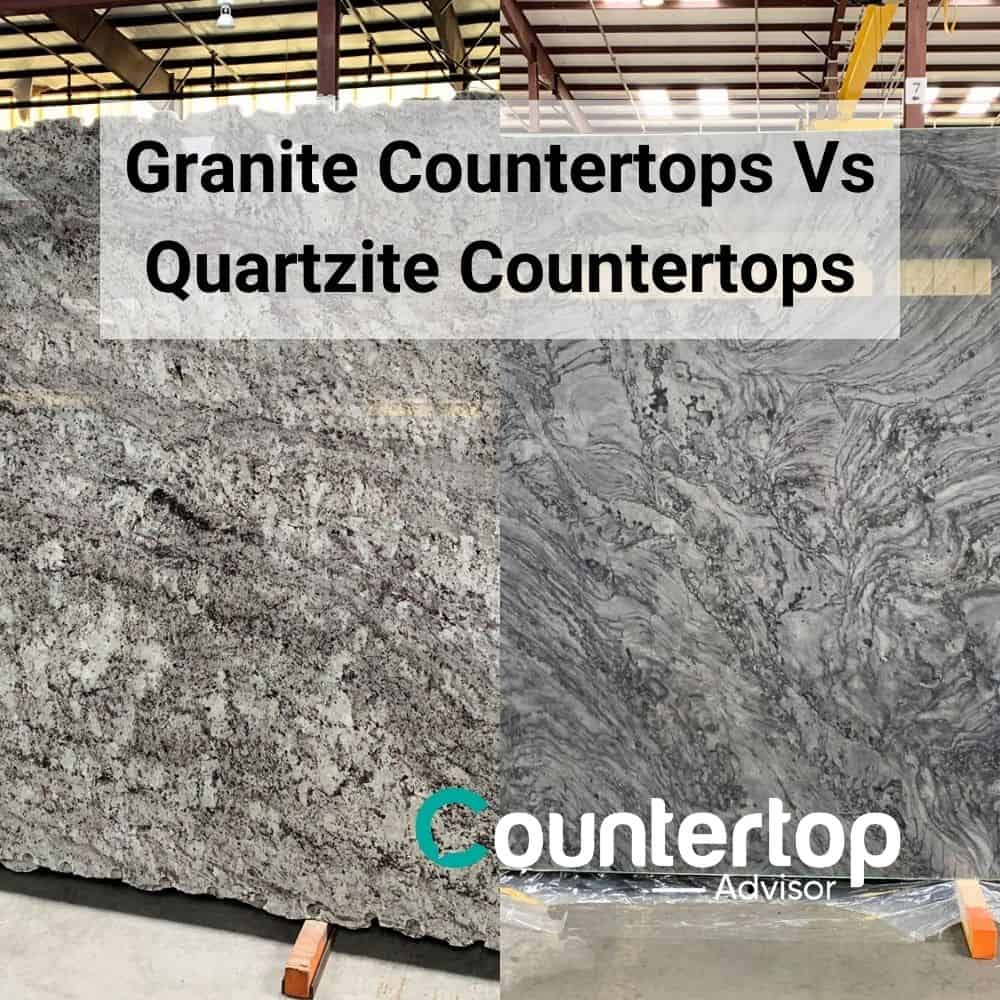
Granite is a natural igneous rock — it forms when magma cools and crystallizes slowly underground. The slow cooling grows large mineral crystals, which is why each granite slab has its distinctive speckled, flecked, one-of-a-kind appearance.
Quartzite is a natural metamorphic rock — it starts as sandstone and is transformed under intense heat and pressure into a dense, quartz-rich stone. Quartzite often shows soft, flowing veining and tends toward whites and grays, frequently resembling marble.
One important buyer warning: stone is sometimes mislabeled, and softer dolomitic marbles are occasionally sold as “quartzite.” Genuine quartzite resists a steel knife and won’t etch from lemon juice — the Natural Stone Institute has flagged this mislabeling as an industry issue; see also my note in can you cut on quartzite.
Durability: Quartzite Edges Ahead, With a Caveat
Quartzite is slightly harder and more scratch-resistant than granite — it’s consistently a 7 on the Mohs scale, while granite ranges 6–7. Quartzite is also very dense and highly heat-resistant. But granite has its own edge: it tends to be a bit more impact-forgiving. Quartzite’s extreme hardness makes it marginally more brittle, so it can be slightly more prone to chipping from a hard impact at edges. In practice, both are extremely durable natural stones that will outlast the kitchen around them — this is a difference of degree, not a dealbreaker either way.
Maintenance: Both Need Sealing
Both granite and quartzite are porous natural stones and both need periodic sealing — this is one area where neither has the advantage that engineered quartz does (quartz never needs sealing). That said, quartzite’s density often means it needs resealing somewhat less often than granite. With both, use the water-drop test rather than a calendar: reseal when water stops beading. See my granite sealing guide and quartzite sealing guide.
Cost: Granite Is the Value Pick
Granite is generally cheaper — roughly $40–$100 per square foot installed against quartzite’s $60–$150. Quartzite typically costs 30–50% more than granite, and the reason is fabrication: quartzite’s extreme hardness demands specialized diamond tooling, advanced CNC machinery, and more skilled labor to cut cleanly without costly mistakes. You’re partly paying for the difficulty of working the stone. Over the long term, quartzite’s slightly lower sealing frequency offsets some of the gap, but granite remains the more budget-friendly natural stone.
Appearance
This often becomes the real deciding factor. Granite gives you speckled, crystalline, flecked patterns with enormous color range — whites to blacks with every shade between. Quartzite gives you softer, flowing, marble-like veining, usually in whites and grays. If you want the look of marble with natural-stone durability, quartzite is the choice. If you want the classic granite crystalline look or a specific bold color, granite. As always with natural stone, view the actual slab before fabrication — names don’t predict appearance.
Which Should You Choose?
Choose granite if: you want the best value in natural stone, you prefer the classic speckled/crystalline look or a bold specific color, or you want slightly better impact-forgiveness. See my granite pros and cons guide.
Choose quartzite if: you want the marble look with real durability, you want the hardest, most scratch-resistant natural option, or you’d rather seal a little less often and don’t mind the higher price.
Honestly, both are excellent. The decision usually comes down to appearance preference and budget — the performance gap is small.
Frequently Asked Questions
Is quartzite better than granite?
Neither is clearly better — both are excellent natural stones. Quartzite is slightly harder and more scratch-resistant and often needs sealing less often; granite is usually cheaper and a bit more impact-forgiving. The choice typically comes down to appearance preference and budget.
Is quartzite more expensive than granite?
Yes — quartzite typically costs 30–50% more, roughly $60–$150 per square foot installed versus granite’s $40–$100. The premium reflects quartzite’s extreme hardness, which requires specialized tooling and more skilled fabrication labor.
Do granite and quartzite both need sealing?
Yes, both are porous natural stones that need periodic sealing — unlike engineered quartz, which never does. Quartzite’s density often means it needs resealing somewhat less frequently than granite. Use the water-drop test to know when.
Which is harder, granite or quartzite?
Quartzite, slightly — it’s consistently Mohs 7, while granite ranges 6–7. Both are hard enough to resist kitchen knives and everyday scratching. Granite is marginally more impact-forgiving at edges.
Does quartzite look like marble?
Often yes — quartzite frequently has soft, flowing white-and-gray veining that resembles marble, which is a big part of its appeal. It gives you the marble look with far better durability and scratch resistance. See my quartzite vs marble comparison.
For the engineered-quartz comparison specifically, see quartz vs quartzite.