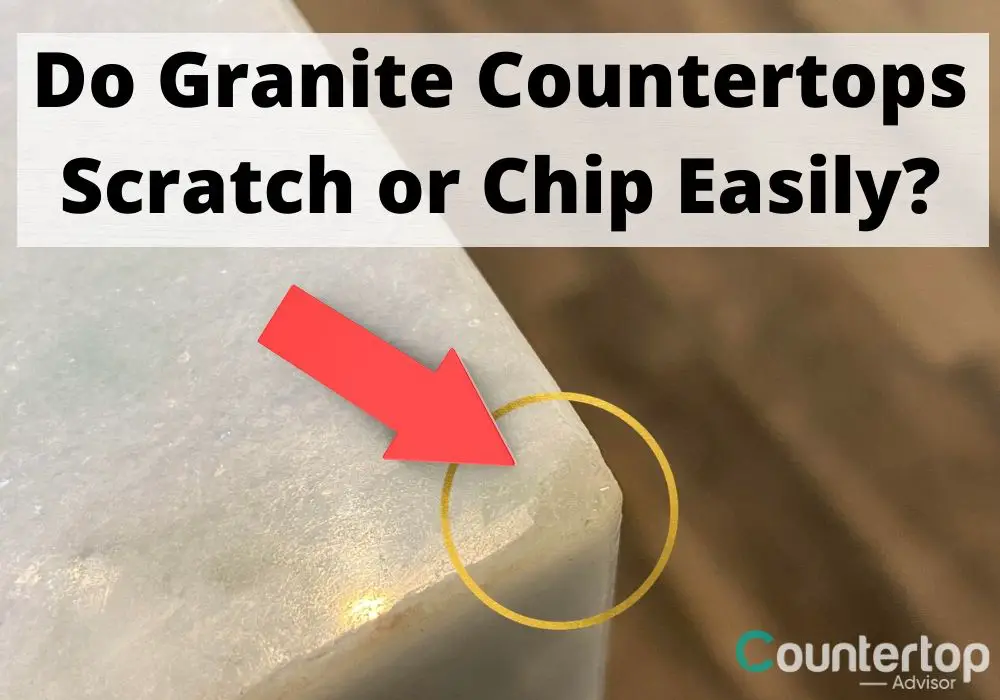
Granite countertops do not scratch easily — the stone rates a 7 on the Mohs hardness scale, harder than your kitchen knives, so normal use won’t mark it. Chips and cracks are a different story: granite is hard but not indestructible, and it’s genuinely vulnerable at specific weak points — the front edges of sink cutouts, island overhangs, and corners. After 10 years installing granite and returning for service calls, I’ll tell you honestly how resistant granite really is to scratches, chips, and cracks, exactly where damage happens, and how to repair each kind.
Do Granite Countertops Scratch Easily?
No. Granite is a 7 on the Mohs hardness scale. Steel kitchen knives are about 5.5. Because the harder material always wins, your knives cannot scratch granite — they dull themselves against it instead. In a decade of service calls, scratched granite was rare, and when it happened it was almost never from knives.
What Actually Causes Scratches in Granite
The few things harder than granite that show up in a kitchen: other pieces of granite or quartz, ceramic with an unglazed grit foot, and certain heavy stoneware. Dragging a rough ceramic pot across the counter, sliding a granite mortar, or scraping with a tool that has a hardened tip can leave a faint mark. Even then, most “scratches” homeowners report turn out to be metal marks (a knife leaving a streak of steel residue, which wipes off) rather than actual grooves in the stone.
How to Fix a Scratch in Granite
Light scratches are cosmetic and don’t penetrate deep. They can usually be buffed out with a granite polishing paste or fine polishing pads — work the paste over the scratch with a soft cloth, following the product directions. A granite polishing compound handles most light marks. Deeper scratches that you can catch a fingernail in need a professional stone refinisher with diamond polishing pads.
Do Granite Countertops Chip Easily?
Granite chips more readily than it scratches — and always at the same predictable places. Chips happen at exposed edges and high-stress points: the front edge of the sink cutout, the corners and overhang of an island, and outside corners of an L-shaped run. The field of the counter — the broad flat area — almost never chips.
The most common cause I saw on service calls: lifting a heavy cast-iron pan out of an undermount sink and clipping the granite edge of the cutout on the way up. The second most common: someone leaning hard on an island corner, or a bar stool back repeatedly knocking the same overhang corner.
How to Fix a Chip in Granite
Small chips — smaller than a dime — are a DIY repair. Use a granite chip repair kit: clean the chip, apply color-matched epoxy with a toothpick or fine putty knife, slightly overfill, let it cure (usually 24 hours), then shave the excess flush with a razor blade. If you saved the original chip, even better — it can be glued back for a near-invisible repair. Larger chips or any chip in a highly visible spot are worth a professional — a fabricator’s color-matched epoxy work is genuinely hard to see.
Do Granite Countertops Crack Easily?
Cracks are uncommon and almost never happen spontaneously. When granite cracks, there’s a reason — and the reason is usually structural, not the stone failing on its own. The causes:
- Inadequate support underneath — cabinet bases sagging, an unsupported overhang, or a wall removed that used to carry part of the run.
- Pre-existing fissures in the slab that weren’t stabilized during fabrication.
- Thermal shock — rare, but repeatedly placing a very hot pan on a cold thin area (near a sink cutout) can stress a hairline crack.
- Impact — a heavy object dropped on a thin or unsupported area.
How to Fix a Crack in Granite
For minor hairline cracks with no missing material, a clear stone glue or thin epoxy fills the surface void — cosmetic, not structural. For wider cracks with missing material, a two-part color-matched epoxy fills the gap and restores some structural integrity — Natural Stone Institute guidance recommends professional assessment for any crack with missing material. The key question: is the crack stable or growing? A stable hairline can be filled and monitored. A crack that spreads week over week signals an underlying structural problem — the support beneath needs to be addressed, and you should call a professional. A crack near an edge or corner that keeps growing is the one to take seriously.
How to Prevent Scratches, Chips, and Cracks
Granite damage is highly preventable. The habits that matter:
- Always use a cutting board. It won’t save the granite (your knives lose that fight), but it saves your knives and protects the sealer.
- Use trivets for sustained heat. Brief contact with a hot pan is fine; a slow cooker running for hours on a thin area is the thermal-shock risk.
- Be careful at the sink cutout. This is the #1 chip location. Lift heavy cast-iron pans straight up, clear of the granite edge.
- Mind island corners and overhangs. Don’t sit or lean on overhangs; make sure overhangs over 10-12 inches have corbel or bracket support.
- Confirm cabinet support during install. Granite is heavy; sagging cabinets are the leading structural cause of cracks. Address this before the stone goes on.
- Keep granite sealed. Sealing doesn’t prevent chips or cracks, but it keeps the surface intact and stain-free, which matters for overall longevity. See my granite sealing guide.
When to Call a Professional
DIY-fixable: light scratches (polishing paste), small chips under a dime (repair kit), stable hairline cracks (clear glue fill). Call a professional for: deep scratches you can feel, large or visible chips, missing chunks, any crack that’s actively spreading, and any damage you suspect is structural. A good stone restorer can make most damage nearly invisible — and if a crack is structural, they’ll find and fix the support problem underneath, which a surface repair alone never will.
Frequently Asked Questions
Can you scratch granite with a knife?
No. Granite (Mohs 7) is harder than kitchen knife steel (about Mohs 5.5), so a knife cannot scratch it — the blade dulls instead. What looks like a scratch from cutting is usually just metal residue, which wipes off. Still use a cutting board, to protect your knives.
Where do granite countertops chip most often?
At exposed edges and high-stress points: the front edge of the sink cutout (the most common spot), island corners and overhangs, and outside corners of L-shaped runs. The broad flat field of the counter almost never chips.
Can a chipped granite countertop be repaired?
Yes. Small chips (under a dime) are a DIY repair with a granite chip repair kit and color-matched epoxy. If you saved the original chip, it can be glued back for a nearly invisible result. Larger or highly visible chips are best left to a professional fabricator.
Why did my granite countertop crack?
Almost always a structural reason, not the stone failing on its own — sagging cabinet support, an unsupported overhang, a pre-existing slab fissure, thermal shock, or impact. A crack that keeps spreading signals an underlying support problem that needs professional attention. See my guide on what causes granite to crack.
Is granite more durable than quartz?
They’re comparable — both Mohs 7, both highly scratch-resistant. Granite handles heat better; quartz resists chips slightly better because it has no natural fissures. For the full comparison see my granite vs quartz guide and how long granite lasts.
Wondering if heat can crack granite? See are granite countertops heat resistant — thermal shock is the one (rare) risk.